
Information service of the Pontifical Mission Societies since 1927
VaticanMedia
by Marie-Lucile Kubacki
Lourdes (Agenzia Fides) – “O Mary, have mercy…” Eva’s crystal-clear voice, that of a 13-year-old girl, rises almost a cappella before Pope Leo XIV. She performs one of the songs from the musical Bernadette of Lourdes. Around her, several sick people sit in their wheelchairs in the heart of the Sanctuary. The scene is brief, simple and permeated by fragility. Yet it conveys the essence of the day: in Lourdes, the most vulnerable are the heart of the Church.
On 27 September, during his visit to the Marian Shrine, the Pope met a crowd of 200,000 pilgrims who had come from France and from throughout the world. During Mass, he paid tribute to “the universal face of the Church”, embodied by pilgrims who had crossed borders and brought their joys and burdens to the Grotto. “What a joy it is to be together, as one heart and one family!” he exclaimed.
The poor and the sick, the Church’s treasure
If all roads lead to Rome, many also lead to Lourdes. People come here to pray, to ask for healing, and sometimes simply to seek a presence. The sick, people with disabilities, families facing hardship, migrants and those wounded by life find a welcome in which vulnerability need not be hidden or justified. What is sometimes, and often, lacking elsewhere is what the Sanctuary seeks to offer: time, attention and a humanity that does not look away.
This spirit of hospitality gave meaning to the Pope’s meeting with the sick and with the staff at the Accueil Notre-Dame. “Fragility is not hidden here; instead it becomes the place of a sacred encounter,” he said. Addressing those who suffer, he added: “You are not a burden; you are the beating heart of our humanity and a precious treasure for the Church.”
The word “treasure” is no coincidence. According to tradition, Saint Lawrence identified the poor as the treasure of the Church. In Lourdes, this treasure is revealed in bodies marked by suffering, but also in those who recognize their own poverty, who are beggars of grace, and who sometimes rebel against illness or injustice. Leo XIV paid tribute to this presence throughout his visit.
At the Grotto of Massabielle, he defended the dignity of life in the face of illness, suffering and old age. “Here, no one is turned away due to their frailty,” he declared during Mass. Your crutches, your wheelchairs and your hidden tears are not obstacles; instead, he said, they are the very place where you are fully respected and welcomed. Lourdes “is blessed as a place for professing the beauty and sanctity of life”.
At the Accueil Notre-Dame, Leo XIV urged healthcare workers to “care for a suffering person, not to eliminate that person”. “What is legal is not necessarily moral,” he added, calling for the development of palliative care and research, and for the sick to be accompanied with tenderness. Doctors, nurses, stretcher-bearers, chaplains, pastoral teams and other volunteers, he recalled, care for bodies and “also care for souls”.
The debate on end-of-life issues, which the Pope had already addressed in his meeting with the bishops of France, forms part of a broader reflection on freedom, suffering and collective responsibility. In Lourdes, however, these words were translated into concrete gestures of welcome and closeness to the sick. Dignity, Leo XIV recalled, does not depend on autonomy or state of health: it belongs to every person simply by virtue of existing.
Acknowledging failings, healing wounds
The Pope urged the bishops not to be discouraged by the errors and failings that have marked the history of the Church. He called on them to acknowledge failings “with a love of the Truth”, to bind up wounds with the charity of the Good Shepherd and to “never grow weary of proclaiming the Gospel”.
The day was also marked by a closed-door encounter with seven survivors of clerical abuse
and the Church in France. At the Bishop’s House in Lourdes, Leo XIV listened individually to their accounts, their suffering and their proposals to ensure that such events never happen again, the Holy See Press Office announced. The Pope prayed with some of them, then thanked the group for their painful testimony and reaffirmed his commitment to ensuring that others do not suffer the same violence. He expressed his closeness to the victims and, through them, to all those who continue to bear the wounds of abuse, expressing the hope that the community of the faithful may increasingly become a place of comfort and healing.
The fragile light
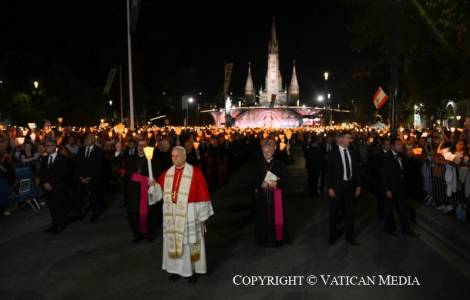
In the evening, the torchlight procession brought pilgrims and the sick together in a single march. The light passed from hand to hand, carried both by those able to walk and by those who were accompanied. “The light that guides us and draws us onward is the light of hope, which never abandons us,” Leo XIV said, evoking a life marked by trials but “already filled with the joy of knowing ourselves to be children of God”.
“Those who are sick,” he added, are “privileged witnesses” to this transfiguration of our lives through faith and love of God. “It is indeed necessary to come here and take part in this procession with you, dear brothers and sisters who are ill, in order to experience this full reality.” He then recalled the words of Pius XII: “No one has ever seen such a procession of suffering in one spot on earth, never such radiance of peace, serenity, and joy.”
In Lourdes, even at night, fragility does not disappear. It moves forward to the rhythm of prayer, illuminated by the fragile light of candles.
(Fides News Agency, 28/9/2026)



 Leo XIV: in the lives of new martyrs and witnesses, the reflection of Christ’s victory over death
 Leo XIV to the new Bishops: Remain with Jesus, the “Good Shepherd,” to keep a missionary heart
 ASIA/HONG KONG - Celebration of the 105th anniversary of the founding of the “Legion of Mary”
 ASIA/VIETNAM - 160,000 people flock to the 32nd Marian Congress-Pilgrimage of La Vang
 Three Churches pray for peace on the border between the Czech Republic, Slovakia, and Poland
 Pope in France/III - Metz, at the roots of European peace in the “city of three borders”
 AMERICA/PERU - Edgard Rimaycuna, secretary to Pope Leo XIV, brings the Pope's blessing to Chiclayo