Information service of the Pontifical Mission Societies since 1927
by Marie-Lucile Kubacki
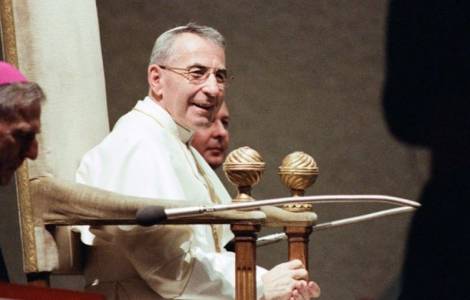
Vatican City (Fides News Agency) – On August 26, 1978, Albino Luciani was elected Pope, taking the name John Paul I. His pontificate lasted only 34 days, but already in his “Urbi et Orbi” Radio Message of August 27, delivered the day after his election, the new Pontiff clearly outlined the guiding principles of his pontificate.
One of his priorities was evangelization as a central dimension of the Church’s mission. “We wish to remind the whole Church that her first duty remains that of evangelization,” the Pope said, explicitly referring to Paul VI’s Apostolic Exhortation Evangelii nuntiandi. The Church, he added, “animated by faith, nourished by the Word of God, and sustained by the heavenly nourishment of the Eucharist,” must “study every path, seek every means, 'opportune importune,' to sow the Word, to proclaim the message, to announce salvation.”
In his Radio Message, John Paul I expressed his determination to continue the legacy of the Second Vatican Council and that of his predecessors, structuring his program around six “we want”: implementing the Council; safeguarding the Church’s “great discipline”; placing evangelization first; pursuing the ecumenical commitment; fostering serene and constructive dialogue; and promoting whatever could “protect and advance peace in our troubled world.” In the Radio Message, the Pope, alongside the other “we want,” pointed to a Church called to “unceasingly pursue the legacy of the Second Vatican Council.”
This was a reflection deeply rooted in the Church’s Tradition and, precisely for that reason, highly relevant today. “He had already assimilated during his priestly formation that vision, dear to the Fathers of the first millennium of the Church, expressed in the mysterium lunae: a Church that does not shine with its own light, but with reflected light; a Church that is not the property of Churchmen, but Christi lumine. ‘Fulget Ecclesia non suo sed Christi lumine’ (the Church shines not with its own light, but with that of Christ),” writes Stefania Falasca, a scholar of John Paul I, postulator of the cause and vice president of the John Paul Vatican Foundation, in an article published in L’Osservatore Romano on August 25. Stefania Falasca notes that, like Paul VI, Luciani had taken this image from St. Ambrose. It was “an image of the nature of the Church and of the action appropriate to it” that had permeated the documents of the Second Vatican Council and become decisive and fruitful in Albino Luciani’s pastoral ministry, long before he was elected to the See of Peter.
The central importance he gave to the Church’s missionary vocation had already marked his ministry as Bishop of Vittorio Veneto and Patriarch of Venice, as highlighted in a 2009 essay by Professor Roberto Morozzo della Rocca entitled L’orizzonte missionario di Albino Luciani (“Albino Luciani’s Missionary Horizon”).
For the Pope, proclamation was not entrusted solely to specialists or ecclesial structures. John Paul I spoke of “all the sons and daughters of the Church,” called to be “tireless missionaries of the Gospel,” so that “a new flowering of holiness and renewal” might emerge in a world “thirsty for love and truth.” The Pope urged the faithful not to conform “to the customs of the world,” nor to “the allurements of easy applause,” but to be ready to give an account of the hope that is within them.
The Church, he continued, is called to offer the world that “surplus of soul” of which it stands in need, at a time when technological progress risks reducing “the earth to a desert, the human person to an automaton, and fraternal coexistence to a planned collectivization.” Addressing missionaries, he greeted “the whole missionary Church” and the men and women working “on the frontiers of evangelization.”
A month later, on September 28, 1978, in an address to a group of Filipino bishops making their ad limina visit, he further clarifies his thoughts. “Among the rights of the faithful, one of the most important is the right to receive the Word of God in all its integrity and purity, with all its demands and its power,” he said. The baptized, he insisted, must be offered the Word of God “in all its integrity and purity.” The Pope stressed that “one of the great challenges of our day is the full evangelization of all those who have been baptized.”
Evangelization, he continued, entails explicit teaching about “the name of Jesus, his identity, his teaching, his Kingdom and his promises.” Among these, “his principal promise is eternal life.” He also recognized “the great vocation of the Philippines” to be “the light of Christ in the Far East,” called to proclaim “his truth, his love, his justice and salvation in word and example” to the peoples of Asia.
As early as his 1966 journey to Burundi, Luciani had demonstrated a concrete understanding of the encounter between the Gospel and cultures. He recognized the decisive role of local clergy, called to guide Churches rooted in the language, history and mentality of their peoples, and he urged missionaries to serve them with humility. At the same time, he rejected ideological oppositions between “foreign” missionaries and indigenous Churches: “There is work for everyone,” he wrote, invoking the Pauline principle: Dummodo Christus annuntietur — “as long as Christ is proclaimed.”
Before the Filipino bishops, he also described Radio Veritas as a “privileged instrument” for proclaiming, together with the whole Church, “that Jesus Christ is the Son of God and the Savior of the world.”
Pope John Paul I was deeply attentive to the development of the means of communication. In his address to representatives of the international press on September 1, 1978, he pledged “frank, honest and effective” cooperation with the instruments of social communication, while acknowledging the risks of “massification and leveling” for the inner life of the human person and his or her capacity for judgment.
He first asked journalists to present the Church “with a love of truth and respect for human dignity,” and then to “comment, at times, on our humble ministry,” again “with a love of truth and respect for human dignity, because such is the purpose of all social communication.” The Church, however, remained his first concern.
On September 4, 1978, addressing the Special Missions present for the beginning of his pontificate, he explained: “We shall endeavor to carry out this service using language that is simple, clear and confident.” The Church, he reminded the Filipino bishops, was irrevocably committed to alleviating poverty and material needs; but her pastoral charity would remain incomplete if she failed also to point to humanity’s “higher needs.”
The biography Io sono la polvere. Biografia ex documentis (“I Am Dust: A Biography from the Documents”) further shows how, as Patriarch of Venice, John Paul I had already addressed the relationship between evangelization and human promotion, defending the primacy of Christian proclamation without separating it from responsibility for people’s concrete needs.
In L’Osservatore Romano, Stefania Falasca recalls that John Paul I emphasized that the Pope and the Holy See did not possess “miraculous solutions to the great problems of the world,” but could “nevertheless give something very precious: a spirit that helps to resolve these problems and places them within their essential dimension, that of openness to the values of universal charity.” For Luciani, support for building a possible peace, inseparable from the Church’s proper mission, was the guiding principle of his entire, brief pontificate.
“Examining Pope Luciani’s pontificate as a decisive passage in the exercise of the Petrine ministry, with enormous repercussions for the life of the Church, helps not only to reconstruct John Paul I’s profile in its entirety, but also to understand the challenges with which the Church was and is called to engage,” Falasca emphasizes, indicating the perspective from which to re-read the legacy of the Venetian Pope.
The re-reading of the six “we want” and their relevance today will be at the heart of the international academic conference “John Paul I: Iustitia et Pax. Protecting and advancing peace in this troubled world,” scheduled for October 13, 2026, at the Pontifical Gregorian University.
The Foundation, established to preserve and promote Luciani’s documentary heritage, now serves as an international reference point for research and scholarship based on the sources relating to his magisterium and ecclesial journey. The archival sources acquired and made available today — the result of the omnino plena research supported for more than a decade by the Cause for the Canonization of Albino Luciani–John Paul I and collected since 2020 by the John Paul I Vatican Foundation — “have opened a new chapter in historiography,” Stefania Falasca writes in L’Osservatore Romano.
These sources, she adds, make it possible to shed light on “the genesis of a project for the governance of the pontificate” and to present the teachings and memory of John Paul I with greater precision.
“Through the Study Days promoted by the Foundation in collaboration with the Pontifical Gregorian University and dedicated to the sources of John Paul I’s Magisterium, the Foundation has continued its scientific research, focusing precisely on the six volumus of Pope Luciani’s program for his pontificate. Each of them will be the subject, over the years, of a dedicated academic conference,” explains the Foundation’s vice president.
The conference is promoted by the John Paul I Vatican Foundation in collaboration with the Pontifical Gregorian University and the Pontifical Committee for Historical Sciences, and will be attended by Cardinal Secretary of State Pietro Parolin, President of the Foundation.
“Examining Pope Luciani’s pontificate as a decisive passage in the exercise of the Petrine ministry,” Falasca says, “with enormous repercussions for the life of the Church, helps not only to reconstruct John Paul I’s profile in its entirety, but also to understand the challenges with which the Church was and is called to engage.”
(Fides News Agency, 25/8/2026)