
Information service of the Pontifical Mission Societies since 1927
by Pascale Rizk
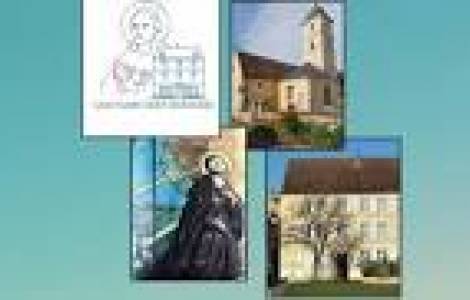
Caen (Fides News Agency) – To ensure that the ancient “Mission of Caen” does not remain merely a historic building but becomes a place of living memory, the Eudist Fathers and Mary, together with the Sisters of Our Lady of Charity of the Good Shepherd in the French province have launched what they call the “Extended Sanctuary” (Sanctuaire Étendu).
It is a pilgrimage route through places, stones and memories, retracing the joys, trials and devotion to the hearts of Jesus and Mary that shaped the spiritual journey of Saint John Eudes (1601–1680), founder of the Congregation of Jesus and Mary (the Eudists) and of the Order of Our Lady of Charity.
The initiative was launched to mark the centenary of John Eudes’ canonization, which took place on May 31, 1925. The pilgrimage consists of four stages, offering visitors an opportunity to deepen their understanding of his spirituality: Les Tourailles, Ri-Halboville, la Delivrande and Caen.
Ri and baptism
Rooted in the rural society of 17th-century Normandy, deeply scarred by the religious wars and outbreaks of plague that plunged numerous families into mourning, the village and church of Ri appear as the tangible cradle of the spiritual roots of St. John Eudes.
“It was following a vow made to Notre-Dame de la Recouvrance des Tourailles that his mother became pregnant, after the couple had suffered from infertility for years,” Sister Nathalie Champ of the Sisters of Our Lady of Charity of the Good Shepherd explains. “After Jean was born, his parents returned to the Sanctuary to give thanks. The couple subsequently had six more children,” she adds.
Jean Eudes was baptized in the Church of Our Lady of the Visitation in Ri, a place he would return to several times throughout his life.
John Eudes regarded his birth as a divine intervention in his parents’ lives. Baptized two days after his birth, he would later see in this event a sign of Mary’s protection, in keeping with the Marian devotion that would characterize his spirituality throughout his life.
For him, baptism was not simply an initiation rite, but an “ineffable generation” and a “wonderful birth” that makes the baptized person a living member of the Body of Christ, animated by the Holy Spirit. John Eudes described the Spirit as “the Spirit of our spirit, the heart of our heart, the soul of our soul, to dwell always with us and in us,” thus emphasizing a Trinitarian intimacy experienced in everyday life.
Ri, therefore, is not merely the geographical birthplace of John Eudes, but the starting point of a baptismal spirituality in which the Holy Spirit, following the example of his action in Mary, forms Christ in the believer and directs the whole of life toward God.
Caen and the itinerant mission
After spending the night in prayer at Notre-Dame de la Délivrande in Douvres-la-Délivrande, 14 kilometers from Caen, John Eudes arrived in the city with five companions on March 25, 1643, the Feast of the Annunciation, with a clear purpose: to found the Congregation of Jesus and Mary and establish the first seminary in Normandy.
Thus began his ministry in Normandy, marked by foundations, trials and perseverance in faith. Despite the closure of the seminary ordered by the Bishop of Bayeux in 1650, “a decision that undoubtedly caused John Eudes great sadness,” Sister Denise Deschamps recalls, “he had an unshakable faith in God’s will.” When the seminary reopened in May 1653, he saw this as confirmation from God of the vocation of the Eudist Fathers.
The rural and impoverished populations, often neglected by the clergy of the time, were at the heart of John Eudes’ mission. Together with a group of priests, Eudes traveled to towns throughout Normandy – Caen, Rouen, Coutances and Évreux – as well as to Brittany (Rennes) and the Nantes region.
He preached in simple manner, organized classes for children and adults, and spent hours with priests hearing confessions, encouraging genuine conversion and reconciliation with enemies. His missions lasted weeks or months.
When he occasionally returned to Caen, it was to encourage the seminarians and to write two of his major works, “The Admirable Heart” and the “Memorial of Ecclesiastical Life.”
As the Eudists and the Sisters of Our Lady of Charity of the Good Shepherd – then known simply as the Sisters of Our Lady of Charity – recall, the present-day oratory stands on the site of the room where John Eudes lived for almost 40 years and where he died in 1680.
“For him,” recalls Sister Madeleine Giugue, who, together with Sisters Denise and Nathalie and the Eudist Fathers in Caen, helps preserve the heritage of the house that he repurchased over the years, “charity is something to be lived at every moment, and it is the rule of all rules.”
Charity was the source of zeal. The missionary spirit that led him to serve, in everyday life, abandoned women without support, through the foundation of the Sisters of Our Lady of Charity.
In recent years, “street missions” have taken on a variety of forms in France. Young people from groups such as Anuncio Mission, Aïn Karem and the Compagnie des Laveurs de pieds go out to witness to their faith among passers-by and tourists, offering prayers, distributing materials and seeking personal encounters, while also supporting local missions.
More recently, some parishes and new communities, such as Chemin Neuf, have also occasionally organized street evangelization initiatives.
(Fides News Agency, 16/8/2026)



 “Gifts to give and gifts to receive”: The Church of the Sheaves opens its first international conference in Rome
 COLOMBIA - "Mission remains urgent": the Colombian Church renews its missionary commitment on the centenary of DOMUND
 ASIA/UNITED ARAB EMIRATES - Abu Dhabi celebrates the 800th anniversary of the death of Saint Francis. Bishop Martinelli: He became a man of peace from the horrors of war he experienced
 New episcopal ordination in China: Ignatius Ding Zuyao ordained Bishop of Haimen
 Three Churches pray for peace on the border between the Czech Republic, Slovakia, and Poland
 ASIA/VIETNAM - 160,000 people flock to the 32nd Marian Congress-Pilgrimage of La Vang