
Information service of the Pontifical Mission Societies since 1927
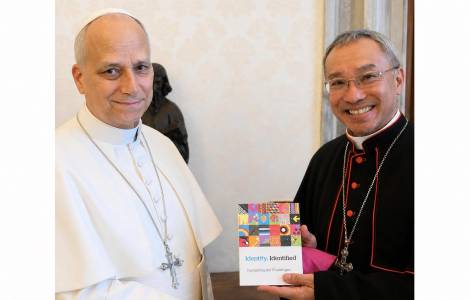
VaticanMedia
by Marie-Lucile Kubacki
Kuching (Fides News Agency) – On the occasion of the ad limina Apostolorum visit of the bishops of Malaysia in June 2026, the Archbishop of Kuching, Bishop Simon Poh, presented Pope Leo XIV with a copy of the project Identity.Identified, a new interactive edition of the New Testament aimed at young people. Already available in English and Bahasa Indonesian, the publication is currently being translated into several other languages, including Spanish, a sign of the growing interest it is arousing in different parts of the world.
Conceived as a pastoral and missionary initiative, Identity.Identified is a unique production of the New Testament “designed for young people who wouldn’t normally read the Bible and who struggle during their teen years in particular to identify their calling in life, especially what God has planned for them,” explains John Bergin to Fides, who has played a key role in the development of the project. The inspiration came in part from reflecting on the topics discussed at the Synod on Youth in 2018 and from a deeply personal experience of grief in his family, which led him to hope that such a tool might help prevent at least one teenager from ever taking their own life because of despair. “It was specifically developed to give young people perhaps the most important thing possible, namely hope”, he adds.
For many years, Bergin has been engaged by Bible Societies around the world “to assist developing plans for promotion and funding of Scripture production and engagement, while also helping them understand the workings of the Catholic Church and importantly how it is leading the revival in Scripture reading and study (specifically through the 3‑year reading cycle).” This experience of mediation between Bible Societies and Catholic pastoral practice has contributed to shaping Identity.Identified as a bridge between the biblical text and the lived questions of young people.
The primary support is the printed New Testament. QR codes inserted into the text lead to video testimonies in which young people share their personal stories. “At the end, they say: ‘You can read my story in the Gospel,’” archbishop Poh explains. “In this way, the testimony leads directly back to the Word of God.” These often moving life stories point to universal struggles such as rejection and loneliness, for which one can find interpretative keys in the biblical text. The reader discovers how some have passed through trial by letting themselves be guided by scriptural figures who themselves were formed by the pedagogy of God. The result is a lively, interactive reading experience of the Book.
Identity.Identified is therefore a pastoral tool designed to reach young people starting from their concrete existential questions. The text of the New Testament remains unchanged, but includes 24 four‑page inserts addressing the major challenges teenagers face, as discussed at the Synod on Youth. The material, drawn from a variety of contributors, addresses these issues from a Catholic perspective. Topics include loneliness, peer pressure, living in a sexualised world, online bullying, dealing with rejection, the search for meaning (“Why am I here?”), the question “Where is God when it hurts?”, anxiety, making good choices, answering “Is life really worth living?”, and understanding climate change. This material was written by bishops and theologians from seven countries in the Asia‑Pacific region, including Cardinal John Dew (New Zealand), Archbishop Mark Coleridge (Australia), the late Cardinal Cornelius Sim (Brunei), Archbishop Simon Poh (Malaysia), Bishop Broderick Pabillo (Philippines), Bishop Michael Dooley (New Zealand) and other Catholic contributors from various countries.
“We identify the questions young people are asking and accompany them in their search for identity in the light of the Word of God,” explains Bishop Simon Poh to Fides. Each theme follows a simple structure: “what the Bible says, what the Church says, and how to respond in practical terms.”
Led by the Bible Society of New Zealand, in collaboration with the United Bible Societies and Catholic partners, the project is part of an ecumenical dynamic. “Bible societies offer an ecumenical service to the Churches,” notes Father Ian Stefanow, general secretary of the Catholic Biblical Federation as he welcomes us into his office. “It is not, first of all, a question of denomination.” This cooperation is also evident in the project’s international development. A Spanish edition is currently being prepared in Latin America. “The biblical text will be from a Protestant edition, but the notes will come from a Catholic Bible,” Father Stefanow explains, describing it as “a well‑negotiated co‑edition.”
Each new version nonetheless requires substantial work of cultural adaptation, especially for the audiovisual content. “The testimonies have to be recreated, because the context changes,” he notes, stressing that these elements are “the most demanding part of the project.” This special New Testament has already been launched in New Zealand, Australia, Vietnam, Malaysia, Indonesia and Canada, and has been translated into several languages. In New Zealand in particular, hundreds of copies have been ordered by different schools, which use it as a required text in their religious education classes.
At a time when initiatives to introduce young people to the Bible are multiplying, Identity.Identified stands out for its close integration of text, pastoral accompaniment and digital tools. Also accessible via a mobile application, the project seeks to respond to new ways of approaching faith. “Today, the challenge is to find how to reconnect young people with the Word of God,” Father Stefanow adds. “That also means finding new languages.” After the Malaysian Youth Day last year, a young person approached Archbishop Poh to inquire where she could get the “GenZ Bible.” “It was only then that I realised that the young GenZ has adopted Identity: Identified that has resonated with their hearts,” he told Fides.
Beyond its format, the initiative is part of a broader renewal of attention to the Bible in the life of the Church, particularly in Asia and Latin America, where many forms of biblical pastoral activity are developing. (Fides News Agency 29/06/2026)



 LEO XIV IN AFRICA - The Pope to the Angolans: The Risen Jesus can also heal the wounds of your people
 Leo XIV: Even in the age of 'Fake News', may the Light of Christian witness shine
 AFRICA/EGYPT - Greek Melkite Bishop Chami: Prayer and fasting for peace and to drive out the demons that fuel wars
 ASIA/CHINA - Word of God, family, pastoral care: Chinese Catholic dioceses launch their "theme years"
 Asia-Pacific Catholic University Choirs gather for Symposium in Hong Kong
 “Doing things for free” is “God’s job”: ‘Operation Mato Grosso’ in Peru