
Information service of the Pontifical Mission Societies since 1927
by Gianni Valente
Rome (Agenzia Fides) – When the Soviet Union expanded its control over Estonia and the other Baltic states in 1940, the German Jesuit Eduard Profittlich, the first Catholic Archbishop of Tallinn, could have returned to Germany. However, he chose to stay because, as he said, "a shepherd belongs to his flock." Less than two years later, he died in a Soviet prison.
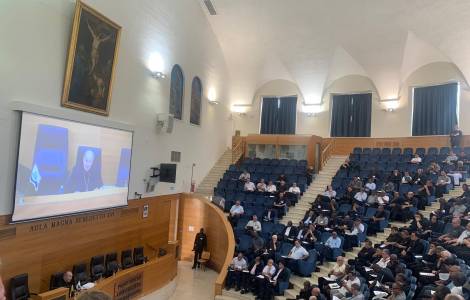
Last Saturday, September 6, Archbishop Profittlich was beatified. The beatification ceremony, held in Freedom Square in Tallinn, was presided over by Cardinal Christoph Schönborn, Archbishop Emeritus of Vienna. Two days later, on Monday, September 8, the Austrian cardinal, in his lecture in the Aula Magna of the Pontifical Urbaniana University, addressed more than 190 recently appointed bishops from five continents, who were currently in Rome attending the formation courses prepared for them by the Dicasteries of the Roman Curia, based his remarks on Profittlich's martyrdom.
Cardinal Schönborn spoke of the courageous attitude with which the martyred Archbishop of Tallinn had lived his vocation to the end and quoted a sentence from his writings: "When I finally realized that I had to stay, my joy was so great that, out of joy and gratitude, I prayed the 'Te Deum'..."
The Cardinal, who celebrated his 80th birthday last January, also spoke in his lengthy lecture about his many years of experience as a theologian, professor, and successor of the apostles, which he used as the basis for his recommendations for the new bishops.
"After 28 years of religious life, it wasn't easy for me," admitted the Cardinal, who belongs to the Order of Friars Preachers (Dominicans), "to become a bishop without the community of brothers in the monastery." "I was very happy," he immediately added, "when I heard that Pope Leo didn't want to live alone in the Apostolic Palace, but rather wanted to live a 'vita communis,' a life in community with three or four fellow brothers of his Augustinian Order."
In this context, the Cardinal recalled other cases of bishops who had surprised him with their decision to exercise their ministry in a climate of fraternity and goodwill. In Lisbon, he recalled, "in the bishop's house, the archbishop, the auxiliary bishops, the chancellor... live in one house, have a common table, and pray together." In Awka, Nigeria, "the bishop's table was open to passing priests. It was a very lively affair." In contrast, "sadness" reigns when a diocese is divided and a climate of mistrust prevails. "It took me years," the Cardinal and theologian confessed, "to free myself from the prejudices that people tried to 'instill' in me, when they too quickly applied categories and labels like left-right, traditionalist-progressive, for me-against me... Little by little, I managed to shed these 'labels' and see people, priests, and other bishops simply as brothers in Christ." "How can I," he added, "be a shepherd if I myself want to anticipate Christ's judgment by trying to separate the sheep from the goats? Pope Francis reminded us so often: todos, todos, todos! 'Who are you to judge?'"
Proximity to Priests and Seminarians
In the dioceses, the Cardinal continued, "priests must feel that the bishop values, respects, and loves them." They should not have to wait "for months" for an appointment with their bishop; rather, it would be sensible to set aside "a weekly day for discussions between priests and the bishop."
With regard to priests, bishops are also called upon to exercise their office as judges and punish abuses by members of the clergy. "Truth and mercy," the Cardinal emphasized, "go together. It is bad when bishops simply abandon their priests when they commit a crime. It is also bad when they fail to lead them to repentance, atonement, or a willingness to punish, or when they even cover up their crimes." And in any case, "the confrere who has committed a crime remains my brother, precisely because he has made a mistake."
Furthermore, the Cardinal further suggested that the bishop should, if possible, get to know his seminarians personally. "Every year," he said, "I offered my seminarians the opportunity to participate in a study week with a vacation. This was a 'legacy' of my academic career. During these weeks, we read great masters such as Thomas Aquinas, Augustine, John Henry Newman, and Ratzinger." An initiative that "can be realized much more easily in a seminary like the one in Vienna than in the Bigard Memorial Seminary in Enugu, Nigeria, which had more than 900 seminarians during my visit," he admitted.
Relations with Politics
The Bishops, according to Cardinal Schönborn, must also engage with the actors and dynamics of politics in their various contexts. He reported that he had this experience in one of the countries once considered "Catholic" and that in recent decades have been gripped by radical secularization processes. "I have always been impressed," added the Archbishop Emeritus of Vienna, "by how Pope Benedict was able to clearly and far-sightedly recognize positive elements in this development. The Church does not want and cannot establish a political state of God."
In the political sphere, the Cardinal advised the new bishops to "cultivate good relations with faithful parliamentarians" and recalled that "we do not need to engage in politics, because they are the representatives of the people who elected them."
In many countries, he added, politicians and parliamentarians of the Catholic faith are "in a minority position" and "must not feel abandoned by their bishops." Furthermore, it is always advisable to seek common ground with "political forces that may not share our faith but stand for our fundamental human principles. For example, in the fight against euthanasia." And wherever possible, "common positions" should be found with other religious communities, following the example of Pope Francis "through his friendship with Sheikh Al-Tayyeb of Al-Azhar University in Cairo."
Women, the poor
Among the young people in the many schools he visited, the Cardinal reported, he encountered an "almost complete lack of understanding" about the fact that "women are not admitted to the ordained ministry in the Catholic Church." Schönborn added that many of the new bishops would also be called upon to "raise their voices loudly" against the exclusion of women from the ordained ministry. "I am firmly convinced," the Cardinal clarified, "that the Church's teaching on this point is unchangeable, as Pope John Paul II stated, referring to a two-thousand-year-old tradition, and clearly stated: 'I have no power to change this.'" This is because "Jesus' election of the Twelve and the unbroken tradition that this constitutes a binding decree of Jesus will remain valid even in the present generation." At the same time, every apostolic ministry is "lived in the spirit and intent of Jesus," who never "treated women with presumption, contempt, or arrogance. How often have I experienced this among us clergy." For this reason, the Cardinal cited as an example, "women must be represented in the bodies of our dioceses: in the seminaries! In the Episcopal Council, and also at the head of the many small parishes." Between past and present, the Cardinal recalled that "Paul and his companions and the young Christian community first gathered at Lydia's house in Philippi." And even today, "many 'recintos' in Latin America are led by women, without competition with priests!"
The Cardinal concluded his speech by recommending that the new bishops also remain in communion with the poor. Not only to avoid "making pious speeches without knowing their true lives," but above all to be supported and guided by their witness of faith. "I will never forget the Moroccan Muslim," the Cardinal recounted, "who sold handkerchiefs on the outskirts of Rome so he could send some money to his family... 'How are you?' I always asked him. 'Everything's fine,' he replied, pointing to heaven." (Agenzia Fides, 8/9/2025)



 ASIA/CHINA - The theological virtue of hope at the heart of the “Advent letters” of the Bishops of Hong Kong and Guangzhou
 AFRICA/NIGERIA - Archbishop of Sokoto: “No one asks the Catholic Church if the figures on persecution are accurate”
 ASIA/MALAYSIA - From the "Great Pilgrimage of Hope," insights for the journey and witness of the Churches of Asia
 Cardinal Parolin: The “Council of Shanghai” and the present of the Church in China
 AFRICA/NIGERIA - Priest kidnapped in Kaduna State
 AFRICA/CAMEROON - The priest abducted by separatists on November 15 is free
 Rome, Manila, Nairobi: Nilda Castro's "long march" between diplomacy and mission
 Erica Siu-Mui Lee: A Chinese Woman's view on the journey of the Church in China after the Council of Shanghai
 VATICAN - Pope Leo XIV proclaims Saint John Henry Newman, Doctor of the Church, Patron of the Pontifical Urbaniana University
 AFRICA/DR CONGO - Seminary formation in the Diocese of Wamba suspended